
Integrate / Product guide
OPC UA & MQTT publishing
The output servers publish the existing cache. They are separate from MQTT acquisition and do not add field-device polling or provide a remote equipment-control interface.
Actual application / 31 October 2026
Inside this workspace.
Captured from the running application. Open any image at full size. Original quality and operating states are retained.
01
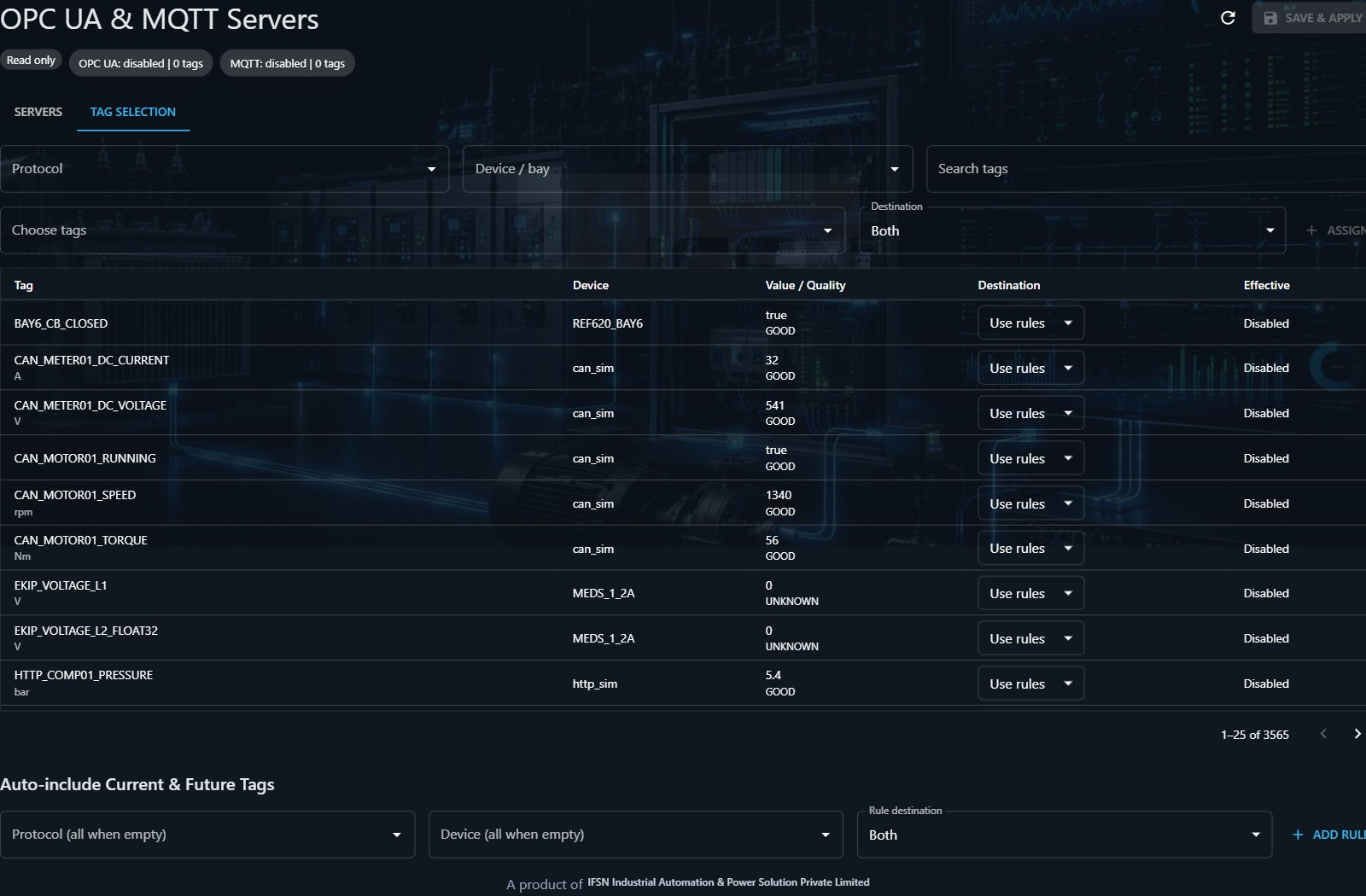
Select the data
Export only the common tags needed by another system.
- Choose OPC UA, MQTT, Both or Disabled per tag.
- Protocol/device auto-include rules support present and future tags, with explicit exclusions.
- Values retain engineering units, source quality and source timestamps in the supported output contract.
02
Authenticated read-only access
Enable each service deliberately on the installation's approved network.
- The documented OPC UA configuration uses username authentication and Sign & Encrypt.
- MQTT output uses authenticated TLS connections and retained latest-value snapshots.
- Both services are disabled until configured; default bindings are loopback scoped.
03
Snapshot semantics
Choose the integration according to the data you need.
- The documented MQTT output is MQTT 3.1.1 with QoS 0 snapshots.
- Raw SV waveforms are not published by these tag snapshot servers.
- Use historian recordings when the workflow requires stored history rather than the latest value.
A typical workflow
- 01Select tags and exclusions for the consuming system.
- 02Configure the server binding, credentials and certificates.
- 03Approve the network path and validate quality/timestamp handling in the client.
Scope for your installation
- This is not a general-purpose bidirectional MQTT broker or a durable event-delivery guarantee.
- Certificate trust, firewall policy and client compatibility require site commissioning. OPC Foundation certification is not claimed.
These guides describe reviewed application modules. The available Windows download is V4.0.0; newer source features may require a later package. IFSN will confirm the modules, compatible hardware and commissioned scope for your release.
Your site. Your requirements.
See how it fits your installation.
Share your relays, meters, sensors, protocols and reporting needs. Our engineers can discuss a demonstration and the appropriate customer package.